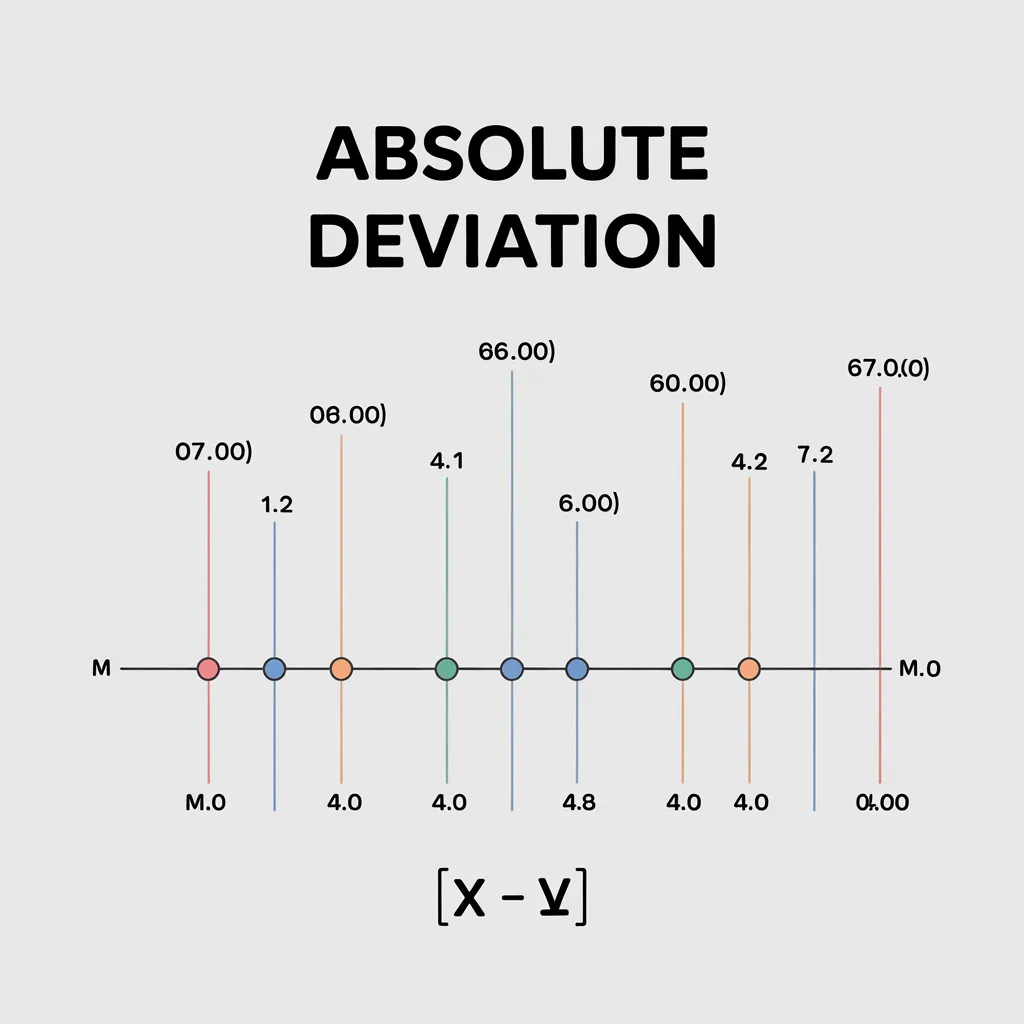
Mean Absolute Deviation is a simple yet powerful way to understand how data values spread around an average. Instead of focusing on complex calculations, it looks at the average distance between each value and the mean. This makes it easier to see how consistent or inconsistent a data set really is. Because it uses absolute values, it avoids confusion caused by positive and negative differences canceling each other out. As a result, mean absolute deviation is widely used in education, statistics, and real-life data analysis where clarity matters most.
Definition & Core Meaning
Mean absolute deviation is a measure of how spread out numbers are around a central value, usually the mean or median.
Core meanings explained simply:
- It calculates the average distance of each value from the center
- It uses absolute values, so negatives never cancel positives
- It shows typical variation, not extreme distortion
Simple explanation:
You take each value, find how far it is from the mean, ignore the sign, and average those distances.
Easy examples:
- “If test scores vary by about 5 points from the average, the mean absolute deviation is 5.”
- “When daily temperatures fluctuate slightly, a low mean absolute deviation confirms stability.”
This clarity is why mean absolute deviation is often preferred in teaching and real-world analysis.
Historical & Cultural Background
The roots of mean absolute deviation stretch back to early statistical thinking, long before modern calculators existed. Ancient mathematicians in Babylon and Greece explored ideas of average distance when comparing measurements, even if they did not use today’s terminology.
Western perspective:
In European mathematics, mean absolute deviation gained attention as a practical alternative to squared-error methods. Early statisticians valued it for its transparency and ease of interpretation.
Asian traditions:
In East Asian scholarship, especially Chinese mathematics, balance and central tendency were emphasized. Concepts similar to average deviation were used in land measurement, astronomy, and taxation systems.
Indigenous knowledge:
Many Indigenous cultures relied on intuitive spread estimation—judging consistency in crop yields, weather patterns, or population counts. These approaches mirror the spirit of mean absolute deviation: understanding variation without unnecessary complexity.
Across cultures, the idea of measuring “how far from normal” has always mattered.
Emotional & Psychological Meaning
Beyond numbers, mean absolute deviation carries a symbolic message about balance and consistency.
- Personal growth: Small deviations from routine are normal and healthy
- Mindset: Stability does not mean perfection, only manageable variation
- Decision-making: Understanding spread reduces anxiety around uncertainty
In psychology, variability often reflects adaptability. Mean absolute deviation reminds us that not all differences are extreme, and not all change is disruptive. It highlights the average impact rather than worst-case fear.
Different Contexts & Use Cases
Personal life:
- Tracking daily expenses to understand spending habits
- Measuring consistency in sleep or exercise routines
Social media:
- Analyzing engagement stability instead of viral spikes
- Comparing follower interaction patterns realistically
Relationships:
- Understanding emotional consistency over time
- Recognizing normal fluctuations without overreacting
Professional usage:
- Finance: assessing price stability
- Education: explaining data spread to students
- Quality control: monitoring manufacturing consistency
See also: Standard Deviation Explained
Hidden, Sensitive, or Misunderstood Meanings
Many people misunderstand mean absolute deviation in critical ways.
Common misconceptions:
- Thinking it replaces all other spread measures
- Assuming it ignores extreme values completely
- Confusing it with mean deviation without absolute values
Cultural misinterpretations:
In some academic systems, MAD is wrongly labeled as “too simple,” despite its robustness.
Context matters:
When data includes extreme outliers, mean absolute deviation often tells a more honest story than squared-based measures.
How to Respond When Someone Asks About It
Casual responses:
- “It shows how far numbers usually are from average.”
Meaningful responses:
- “It measures typical variation without exaggerating extremes.”
Fun responses:
- “It’s like measuring how far life drifts from normal—on average.”
Private or professional responses:
- “It’s a transparent way to understand data consistency.”
Regional & Cultural Differences
Western education:
Often introduced early as a stepping stone to advanced statistics.
Asian education:
Emphasized for balance and clarity before complex formulas.
Middle Eastern scholarship:
Historically valued practical averages in trade and astronomy.
African & Latin approaches:
Used intuitively in agriculture, economics, and population studies.
Despite different teaching styles, the core meaning stays universal.
Why Mean Absolute Deviation Is Easy to Interpret
Mean absolute deviation speaks the language of real distance. Instead of abstract squares or complex transformations, it tells you how far values usually sit from the center. This makes results intuitive for students, analysts, and decision-makers alike. You do not need advanced math skills to understand what the number is saying.
Mean Absolute Deviation vs Real-World Noise
In real data, noise is unavoidable. Small errors, fluctuations, or irregular behavior appear everywhere—from sales numbers to weather readings. Mean absolute deviation handles this noise calmly. It reflects typical variation without letting random spikes dominate the outcome.
Role of Mean Absolute Deviation in Education
Educators often introduce mean absolute deviation before more complex measures. It helps learners build statistical intuition early. By focusing on average distance, students grasp the idea of spread faster and gain confidence when moving toward advanced concepts later.
Why Mean Absolute Deviation Supports Fair Comparisons
When comparing two data sets, exaggerated extremes can distort judgment. Mean absolute deviation keeps comparisons fair by treating all deviations equally. This allows clearer evaluation of consistency between groups, time periods, or performance metrics.
Limitations of Mean Absolute Deviation
While powerful, mean absolute deviation is not perfect. It does not emphasize extreme values, which may be important in risk analysis or safety studies. In situations where rare events carry high impact, additional measures may be needed alongside it.
Mean Absolute Deviation in Data Transparency
Transparency matters when explaining results to non-experts. Mean absolute deviation offers openness because its calculation is easy to explain and verify. This builds trust in reports, research findings, and data-driven decisions.
When Mean Absolute Deviation Is the Best Choice
Mean absolute deviation works best when clarity, fairness, and robustness matter more than mathematical sensitivity. It is ideal for everyday analysis, learning environments, and practical reporting. In these cases, it delivers insight without confusion.
FAQs
1. What does mean absolute deviation measure?
It measures the average distance of values from a central point.
2. Is mean absolute deviation better than standard deviation?
It depends on context; MAD is simpler and more robust to extremes.
3. Can mean absolute deviation be zero?
Yes, if all values are identical.
4. Why use absolute values in MAD?
To prevent positive and negative differences from canceling out.
5. Is MAD affected by outliers?
Less than squared-based measures, but not immune.
6. Where is MAD commonly used?
Education, finance, quality control, and data analysis.
Conclusion
Mean absolute deviation explains how much values typically differ from the average in a clear and honest way.
It avoids exaggeration and keeps variability easy to understand.
This makes it especially useful for real-world analysis and learning.
When clarity matters more than complexity, mean absolute deviation is the right choice.
discover more post
Uncovering the Truth Behind “What Does WYO Mean” 2026
What Does Indicted Mean? Hidden Legal Truths 2026
Sample Messages Asking for Financial Help
