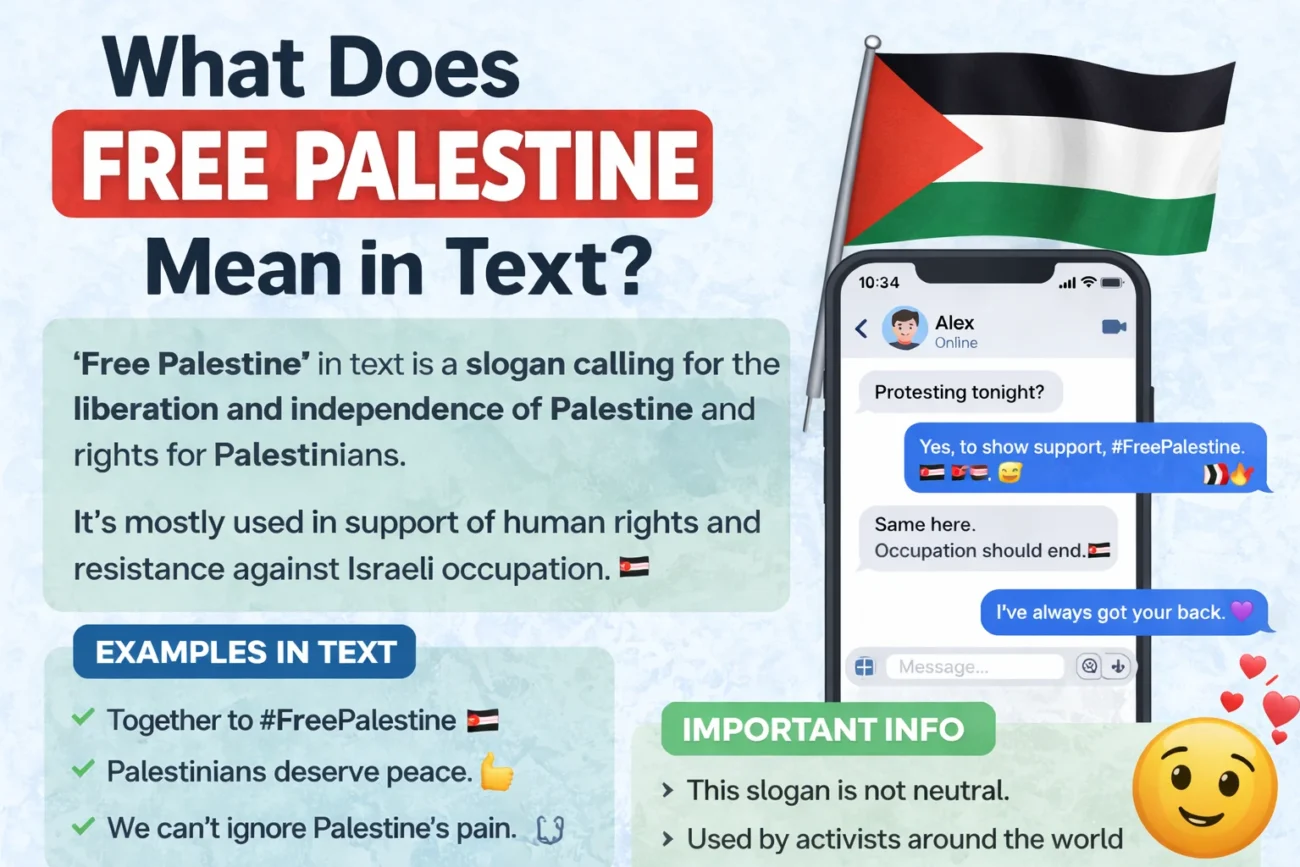
If you’ve spent any time on social media, you’ve probably seen the phrase “Free Palestine” appear in comments, captions, hashtags, or even usernames. For some people, it’s immediately clear what it means. For others—especially beginners exploring internet language—it can feel confusing, political, or even overwhelming.
So what does “Free Palestine” actually mean in text? Is it just a slogan? A hashtag trend? Or something deeper?
In this guide, we’ll break it down in a simple, clear, and human way. You’ll learn the meaning, where it comes from, how people use it online, and what context matters when you see it.
What Does “Free Palestine” Mean?
At its core, “Free Palestine” is a phrase people use to express support for freedom, rights, and self-determination for Palestinians.
In simple terms, when someone writes “Free Palestine,” they are usually saying:
- Palestinians should have freedom and independence
- They should live without occupation or restriction
- They deserve basic human rights and safety
It’s not just internet slang—it’s a political and humanitarian statement that has existed long before social media.
Why Do People Use It in Text and Online?
On platforms like Instagram, TikTok, X (Twitter), and Facebook, people often use short phrases to express big ideas. “Free Palestine” became popular online because it’s:
- Short and easy to share
- Emotionally powerful
- Recognizable worldwide
People use it to:
- Show support or solidarity
- Raise awareness about current events
- Join conversations about global issues
- Respond to news or videos
In many cases, it works like a digital expression of activism.
Is “Free Palestine” Just a Hashtag?
Not exactly.
While you’ll often see it written as #FreePalestine, it’s more than just a hashtag trend. It’s part of a larger movement that exists both online and offline.
On social media, hashtags help:
- Spread awareness quickly
- Connect posts on the same topic
- Make content easier to find
But the meaning behind the phrase doesn’t depend on the hashtag—it’s about the message itself.
The Meaning Behind the Phrase (Simple Explanation)
To understand the phrase better, think of it like this:
- “Free” = wanting freedom or liberation
- “Palestine” = referring to Palestinian people and land
So together, it means:
👉 “Let Palestinians live freely and independently.”
Different people may interpret it slightly differently, but most uses revolve around freedom, rights, and justice.
Examples of “Free Palestine” in Text
Here are some common ways you might see it used online:
1. In Comments
“Praying for peace. Free Palestine.”
2. In Captions
“Stand for humanity. Free Palestine.”
3. As a Hashtag
#FreePalestine #HumanRights #Peace
4. In Bios
“Justice. Equality. Free Palestine.”
5. In Conversations
Person A: “Did you see the news?”
Person B: “Yeah… it’s heartbreaking. Free Palestine.”
In all these examples, the phrase expresses support or concern.
Is It Political?
Yes—it is connected to politics, but it’s also about human rights.
Some people use the phrase purely from a humanitarian perspective (concern for people’s safety and rights), while others use it in a more political context.
Because of this, reactions to the phrase can vary depending on:
- Personal beliefs
- Cultural background
- Knowledge of the issue
That’s why context matters a lot when you see or use it.
Why Is It Trending on Social Media?
“Free Palestine” trends online during times of major news events or conflicts. When something significant happens, people turn to social media to:
- Share information
- Express emotions
- Show solidarity
This leads to the phrase appearing frequently across platforms.
Social media amplifies voices quickly, so even a short phrase can reach millions of people in hours.
Is It Okay to Use the Phrase?
This depends on your intention and understanding.
Before using it, it’s important to:
- Know what it represents
- Understand that it’s a serious topic
- Be respectful of different perspectives
For many people, it’s not just a trend—it’s something deeply meaningful.
Common Misunderstandings
1. “It’s just a trend”
Not true. While it trends online, the phrase has existed for decades and is rooted in real-world issues.
2. “Everyone means the same thing”
Not exactly. People may use it with slightly different meanings or motivations.
3. “It’s only political”
It can be political, but many people use it from a humanitarian perspective.
Similar Phrases You Might See
If you’re exploring internet language, you might also come across related expressions like:
- “Stand with Palestine”
- “Justice for Palestine”
- “Peace for all”
These phrases often appear in the same discussions and carry similar tones of support or awareness.
How to Respond When You See It
If you see “Free Palestine” online and aren’t sure how to react, here are some options:
- Learn more before forming an opinion
- Respect the conversation, even if you disagree
- Avoid arguing without understanding the topic
Social media discussions around this phrase can become emotional, so it’s best to approach them thoughtfully.
Why Context Matters So Much
The meaning of “Free Palestine” can change slightly depending on where and how it’s used:
- In a news post → likely reacting to current events
- In a bio → expressing personal beliefs
- In comments → showing support or empathy
Always look at the surrounding content to understand the intent.
Final Thoughts
“Free Palestine” is more than just a phrase you see in comments or hashtags. It’s a powerful expression tied to real people, real struggles, and real emotions.
In simple terms, it usually means:
👉 Support for freedom, rights, and justice for Palestinians
If you’re new to internet language, the key takeaway is this:
- Not all phrases online are just slang
- Some carry deep meaning and history
- Understanding context makes all the difference
By taking the time to learn what phrases like this mean, you become a more informed and thoughtful participant in online conversations.
descover more post
Absolute Deviation Mean Hidden Truths Behind Data …
What Does a Semicolon Tattoo Mean? Powerful Truth …
89+ Angry Messages to Let Someone Know How You Feel …
