If you’ve spent any time on social media, texting friends, or scrolling through comments, you’ve probably seen the word “ion” pop up and thought… wait, what does that even mean?
You’re not alone. Internet slang evolves fast, and “ion” is one of those terms that can confuse beginners because it looks like a science word—but it’s actually something completely different in texting.
In this guide, we’ll break down exactly what “ion” means, how people use it, where it came from, and how you can start using it naturally without sounding awkward.
What Does “Ion” Mean in Text?
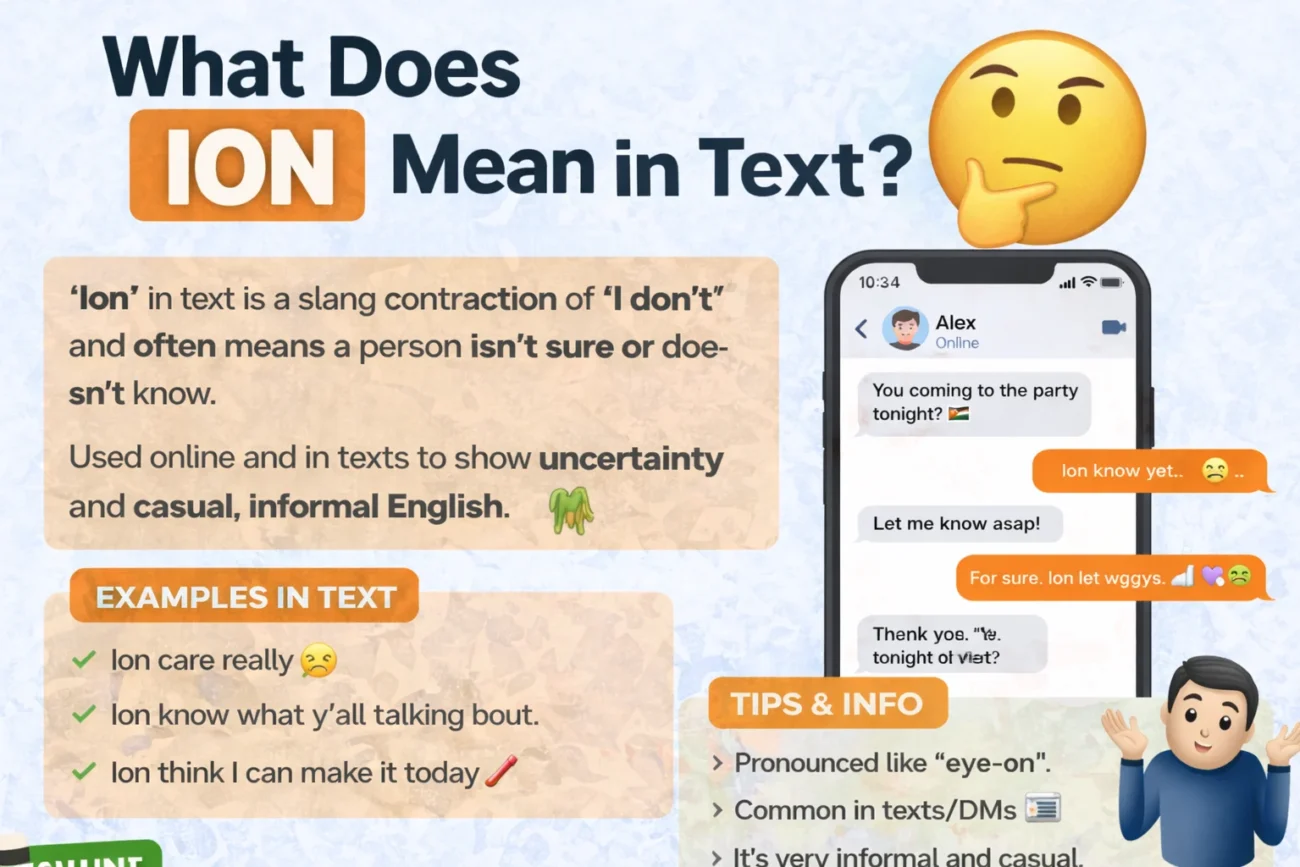
In texting and online slang, “ion” simply means “I don’t.”
Yes, it’s that simple.
It’s a shortened, stylized version of:
- I don’t know → “ion know”
- I don’t want to → “ion wanna”
- I don’t care → “ion care”
Instead of typing the full phrase, people drop the “I don’t” into one quick word: ion.
Why Do People Say “Ion” Instead of “I Don’t”?
Language on the internet is all about speed, convenience, and vibe.
Here’s why “ion” became popular:
1. Faster typing
Typing “ion” takes way less effort than “I don’t,” especially in quick chats.
2. Casual tone
It sounds more relaxed and informal. It gives off a chill, laid-back vibe.
3. Cultural influence
“Ion” comes from spoken language patterns, especially in certain dialects where “I don’t” naturally sounds like “ion” when said quickly.
4. Social media trends
Platforms like TikTok, Twitter (X), and Instagram helped spread it quickly.
Common Examples of “Ion” in Text
Let’s look at how “ion” is actually used in real conversations.
Example 1: Expressing uncertainty
- “ion know what he talking about”
- Translation: I don’t know what he’s talking about
Example 2: Saying you don’t want to do something
- “ion feel like going out today”
- Translation: I don’t feel like going out today
Example 3: Showing disinterest
- “ion care anymore”
- Translation: I don’t care anymore
Example 4: Reacting casually
- “ion think that’s a good idea”
- Translation: I don’t think that’s a good idea
Notice how it blends smoothly into sentences without capital letters or punctuation. That’s part of the style.
Is “Ion” the Same as the Science Term?
No—and this is where many people get confused.
In science, an ion is a charged particle (like in chemistry or physics).
But in texting, “ion” has nothing to do with science at all.
The meaning completely depends on context:
- In school → it’s about atoms and electricity
- In texts or social media → it means “I don’t”
So if someone texts “ion know,” they’re definitely not talking about chemistry.
Where Did “Ion” Come From?
“Ion” didn’t just appear out of nowhere. It evolved from natural speech.
When people say “I don’t” quickly, it often sounds like:
- “I-on”
- “ion”
Over time, that spoken version made its way into texting.
It became especially popular through:
- Hip-hop culture
- Online communities
- Short-form content platforms
As more people started writing how they speak, “ion” became widely accepted slang.
When Should You Use “Ion”?
“Ion” is great—but only in the right context.
Use it when:
- You’re texting friends
- You’re chatting casually online
- You’re posting on social media
- You want to sound relaxed and informal
Avoid it when:
- Writing emails
- School assignments
- Professional messages
- Formal situations
Think of it like wearing sneakers—you wouldn’t wear them to a formal event, but they’re perfect for everyday use.
Variations of “Ion” You Might See
People don’t always use “ion” the same way. Here are some common variations:
1. “Ion know”
Meaning: I don’t know
2. “Ion wanna”
Meaning: I don’t want to
3. “Ion got”
Meaning: I don’t have
4. “Ion even”
Meaning: I don’t even
Example:
- “ion even like that movie”
How “Ion” Changes the Tone of a Message
Using “ion” doesn’t just shorten your sentence—it changes how it feels.
Compare these:
- “I don’t care.” → sounds more serious or direct
- “ion care” → sounds more casual, relaxed, maybe even playful
That subtle difference is why people prefer slang in friendly conversations.
Is “Ion” Considered Proper English?
No, “ion” is not standard English.
It’s slang.
That doesn’t make it wrong—it just means it’s context-dependent.
Language constantly evolves, and slang plays a huge role in how people communicate today.
How to Use “Ion” Naturally (Without Sounding Forced)
If you’re new to using slang, it can feel awkward at first. Here’s how to ease into it:
Start simple
Use it in common phrases like:
- “ion know”
- “ion think so”
Match your environment
If your friends use it, it’ll feel natural. If not, it might feel out of place.
Don’t overuse it
Using “ion” in every sentence can feel forced. Mix it with normal language.
Common Mistakes to Avoid
1. Using it in formal writing
Avoid writing:
- “Ion understand the assignment requirements”
Instead:
- “I don’t understand the assignment requirements”
2. Misreading it as something else
Some people confuse “ion” with:
- “I’m”
- “on”
- Or the science term
Context is key.
3. Overcomplicating it
It’s just “I don’t.” Nothing more.
Why Slang Like “Ion” Matters
You might wonder—why does this even matter?
Understanding slang helps you:
- Communicate better online
- Understand messages faster
- Stay updated with modern language
- Avoid confusion in conversations
It’s like learning a new dialect of English used on the internet.
“Ion” vs Similar Slang Terms
Here are a few similar slang expressions and how they compare:
“Idk”
- Meaning: I don’t know
- More neutral and widely used
“Ion know”
- Same meaning, but more casual and stylistic
“I dunno”
- Informal spoken version
Each one has a slightly different tone, even though they mean the same thing.
How Popular Is “Ion” Right Now?
“Ion” is widely used, especially among:
- Teenagers and young adults
- Social media users
- Online communities
It’s not going anywhere anytime soon, but like all slang, its popularity may change over time.
Should You Start Using “Ion”?
That depends on your style.
If you:
- Like casual texting
- Want to sound more natural online
- Are active on social media
Then yes, it’s worth using.
If you prefer:
- Clear, standard English
- Professional communication
Then you can skip it.
There’s no rule—you choose what fits your voice.
Final Thoughts
So, what does “ion” mean in text?
At its core, it’s just a simple, casual way of saying “I don’t.”
It’s fast, expressive, and fits perfectly into modern digital conversations. Once you understand it, you’ll start noticing it everywhere—and it’ll make a lot more sense.
Language on the internet keeps evolving, and “ion” is just one example of how people shape communication to be quicker, easier, and more personal.
Now that you know what it means, you can confidently read it, understand it, and even use it yourself—if it feels right.
descover more post
89+ Angry Messages to Let Someone Know How You Feel …
Absolute Deviation Mean Hidden Truths Behind Data …
What Does a Semicolon Tattoo Mean? Powerful Truth …
